S3 T2 Econ
Opportunity Cost
Highest Valued Option Forgone
Explicit Cost
- out-of-pocket cost
- payment in taking the action
- e.g. money, trade items
Implicit Cost
- opportunity cost
- not an actual payment
- e.g. time cost
- Highest Valued Alternative Use of Time
Sunk / Historical Cost
- Wasted time should not be considered
Demand & Supply
Individual Demand
- shows the amount of a good a buyer is willing and able to buy at all given prices over a period of time, ceteris paribus.
Law of Demand
- When the price of a good rises/drops, the quantity demanded drops/rises, ceteris paribus.
- Price and Quantity Demanded are negatively related. According to the la of demand, the demand curve should be downward sloping.
Equilibrium
Quantity Demanded = Quantity Supplied
Change in Demand & Supply
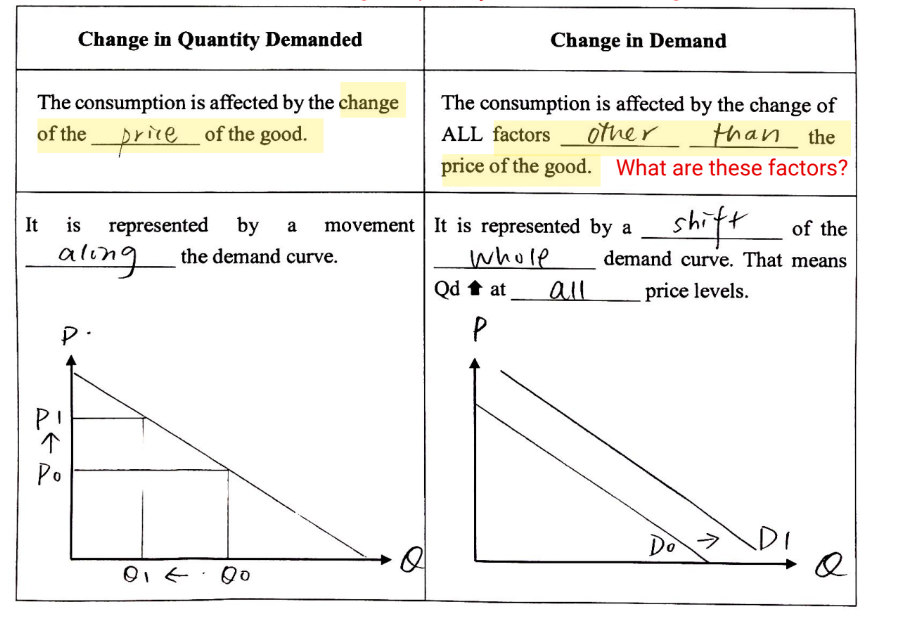
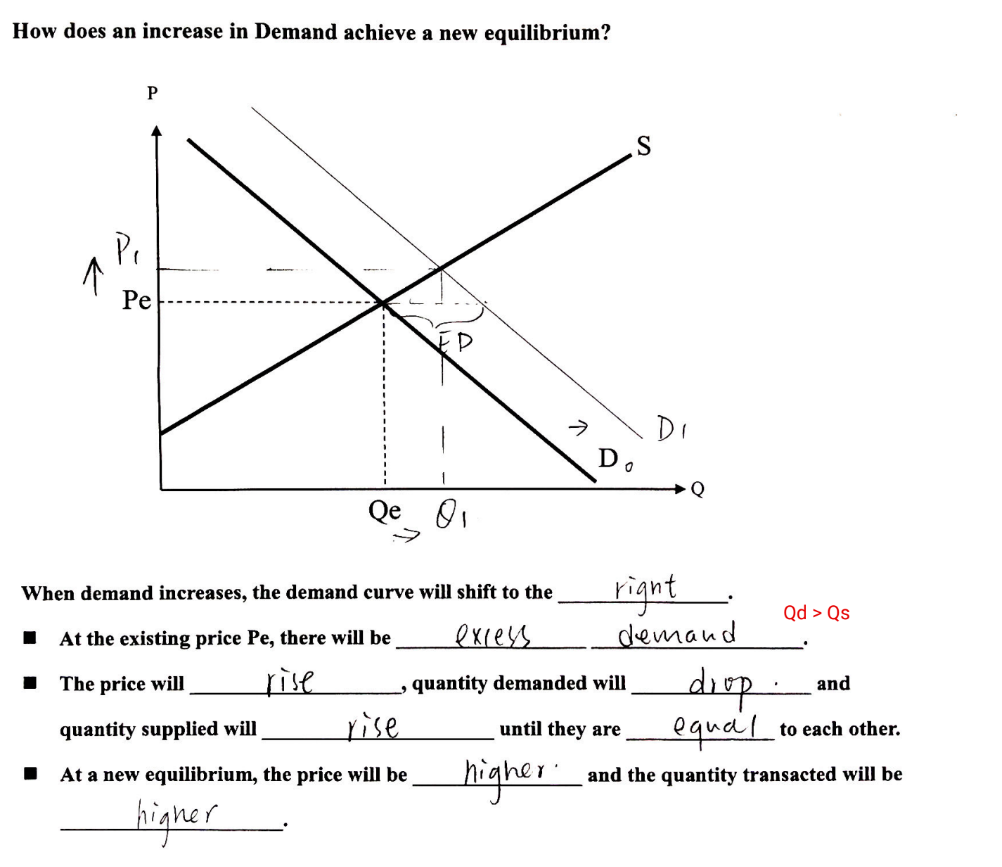
Price of Substitute
Competitive Demand
Price of MTR increases, Demand for bus services increase
Price of complement
Joint Demand
Price of cars decreases, Demand for Gasoline increases
Income increases
Demand for Superior Goods increase
Demand for inferior/normal goods decrease
Specialization / Division of labour
In production, people are usually responsible for 1 task / good only
Simple Division of Labour
- A worker specialises in producing a particular type of goods or providing a particular type of services
- Different people produce different goods/services
- e.g. doctor, engineer, domestic helper: all not related
Complex Division on Labour
- A worker specialises in one stage of a production process
- A production is divided into different stages of production of the same good
Regional Division of Labour
- A country or a region specialises in producing a particular type of goods or providing a particular type of services
- Different countries / regions produce different goods / services
Why division of labour?
- Raise labour productivity
More output can be produced with the same amount of labour - Raise labour productivity
- Practice makes perfect
- Save time in training and job rotation
- Manager can choose the most suitable person for the job
Workers to what they can do best- Save resources from producing capital tools
Disadvantages of specialization
Workers: bored
- Repeat the job every day
- Feel bored
- Lose working interest
- Productivity drops
Production stages are interdependent
- One stops, whole production process will be affected
Workers face higher risk of unemployment
- Workers learn 1 skill only
- Difficult for them to change jobs
Consumer have fewer choices
- Machines are usually used
- Products are standardized
Limitations of Specialization
- Difficult / unnecessary to practice specialization if
- the firm is too small
Too few workers - the market is too small
Small output is enough to satisfy the market demand
- the firm is too small
Fixed Costs
- Costs do not change with output level
- E.g. rent
Variable Costs
- Costs change with output level
- e.g. Gas, Electricity, Water
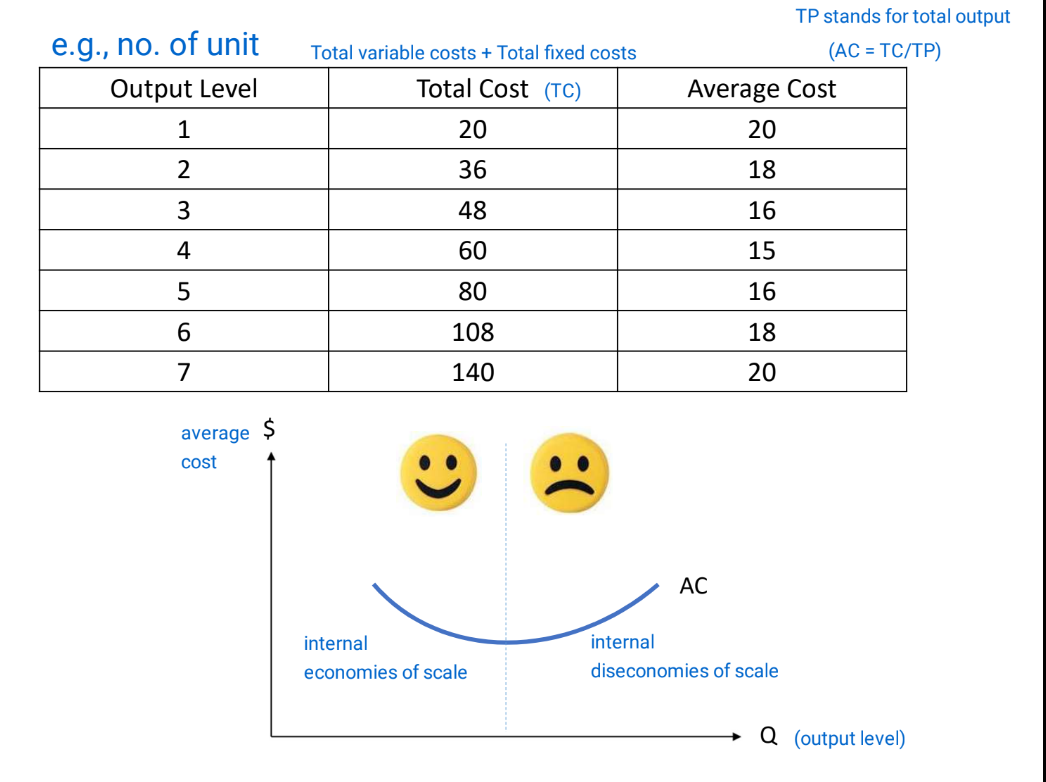
Internal Economies of scale
Financial Economies
- Lower interest rate due to goodwill
Purchasing Economies
- Discounts due to buying in bulk
Marketing Economies
- Advertising Cost nearly the same even with more output
- Average Cost drops